Every small business owner reaches the same moment: customers are searching online, competitors already have a website, and yours is either missing, outdated, or slow. The good news is that affordable website design no longer means a cheap, generic template. In 2026, budget-friendly websites can be fast, mobile-ready, AI-search-optimized, and built to convert visitors into paying customers.
This guide breaks down what affordable website design actually includes today, what changed in 2026, and how to choose the right web design services for your business without overpaying or underdelivering.
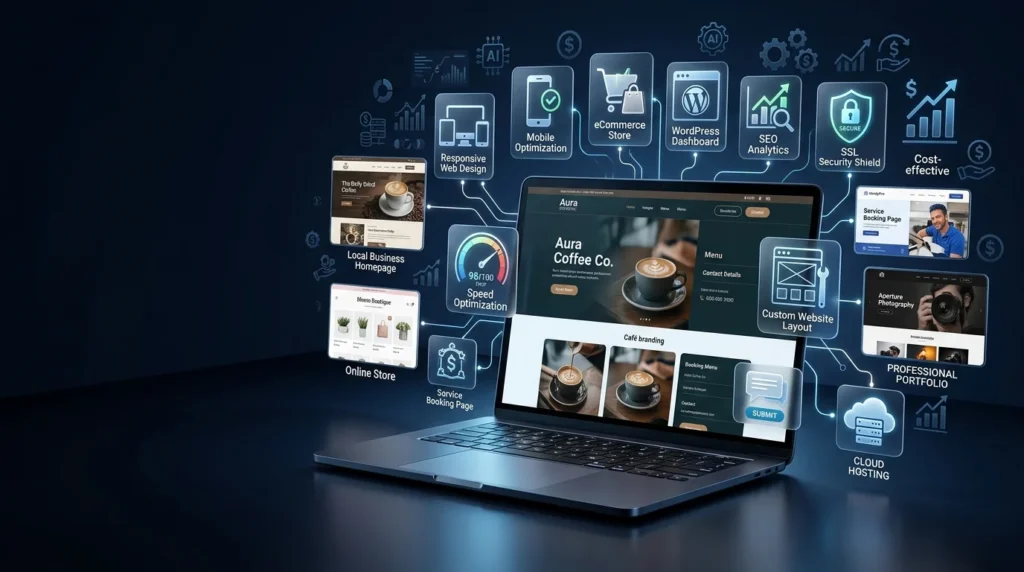
Image: affordable-website-design-mockup-2026.webp Alt text: Affordable website design mockup showing a responsive small business homepage on desktop and mobile
What “Affordable Website Design” Means in 2026
A few years ago, “affordable” often meant a stripped-down site with limited features. That has changed. Rising competition among web design agencies, no-code tools, and streamlined development workflows have made affordable web design genuinely capable — not a compromise.
A properly built affordable website today should still include:
- A custom layout matched to your brand (not a recycled template)
- Full mobile and tablet responsiveness
- Clean, fast-loading code
- Basic on-page SEO from day one
- A working contact form or booking system
- Room to grow into e-commerce or advanced features later
If a provider strips out any of these to hit a low price, that’s not affordable — that’s incomplete. Real small business website design balances cost with the essentials that actually generate leads.
Why Every Small Business Needs a Website in 2026
Search behavior has shifted. Customers no longer only “Google” a business — they ask AI assistants and chat-based search tools for recommendations, and those tools pull directly from well-structured business websites. A business without a clear, well-optimized website is increasingly invisible in both traditional search and AI-generated answers.
That’s why professional website design now has to satisfy two audiences at once: real human visitors and the search/AI systems that decide who gets recommended.
2026 Updates That Changed Website Design
Website design has evolved quickly. Here’s what’s different this year compared to previous years, and why it matters for anyone budgeting for a new site.
1. AI Search and AEO/GEO Are Now Part of SEO
Search engines and AI assistants (like AI Overviews and chat-based search tools) now generate direct answers instead of just listing links. This has created two new practices that sit alongside traditional SEO:
- AEO (Answer Engine Optimization): structuring content so AI tools can lift a clear, direct answer from your page.
- GEO (Generative Engine Optimization): optimizing your site’s structure, schema, and content so generative AI systems reference your business as a trusted source.
In practice, this means every page needs clear headings, direct answers near the top of sections, FAQ sections, and structured data (schema markup) — not just keywords.
2. Core Web Vitals and Speed Are Non-Negotiable
Page speed has been a ranking factor for years, but in 2026 it directly affects whether AI crawlers can efficiently process and trust a site. Slow, bloated websites are quietly deprioritized. Any website redesign services package worth paying for should include image compression, caching, and clean code as standard, not an upsell.
3. Mobile-First Is the Only Option
Mobile traffic continues to dominate. Search engines index the mobile version of a site first, so a site that “looks fine on desktop” but breaks on mobile is effectively broken for ranking purposes.
4. Accessibility and Trust Signals Matter More
Clear navigation, readable fonts, alt text on images, and secure (HTTPS) connections are now baseline trust signals — both for visitors and for how AI systems evaluate credibility before recommending a business.
5. Conversion-Focused Design Beats “Pretty” Design
A visually nice site that doesn’t guide visitors to call, message, or buy is a missed opportunity. 2026-era business website design prioritizes clear calls-to-action, simple booking/contact flows, and content organized around what the customer actually wants to know.
Image: web-design-services-checklist-2026.webp Alt text: Checklist comparing speed, mobile responsiveness, SEO, and AI-readiness in 2026 website design services
Core Elements of an Affordable, High-Performing Website
Whether you need a brand-new site or a website redesign project, these are the building blocks that matter most.
1. Clean, Custom Design
Templates are fine as a starting point, but custom website design means the layout, colors, and structure are adapted to your actual brand and customer journey — not just a logo swap on a stock theme.
2. Mobile Responsiveness
Every element — menus, forms, images, buttons — needs to work smoothly on a phone screen. This is the single most common reason budget websites fail to perform.
3. Fast Loading Speed
Compressed images, minimal plugins, and clean code keep load times under a few seconds. Speed affects both user experience and search visibility.
4. On-Page SEO Foundations
Keyword-optimized titles, meta descriptions, header structure, and internal linking should be built in from the start, not added later as a separate expense.
5. Clear Calls-to-Action
Every page should guide the visitor toward one next step: call, message, book, or buy.
6. Scalability
A good affordable website is built on a flexible platform like WordPress so you can add a blog, online store, or booking system later without rebuilding from scratch.
Image: custom-website-design-elements.webp Alt text: Core elements of custom website design including responsive layout, fast speed, and clear calls-to-action
Website Design vs. Website Redesign: Which Do You Need?
If you already have a website that looks outdated, loads slowly, or isn’t generating leads, you likely need website redesign services rather than a brand-new build. A redesign keeps your existing content and domain authority while modernizing the design, speed, and structure.
Signs it’s time for a redesign:
- The site hasn’t been updated in 3+ years
- It doesn’t display properly on mobile
- Load times are slow
- There’s no clear path for visitors to contact you
- Your competitors’ sites look noticeably more modern
If you’re starting from nothing, custom website design built around your brand from day one is usually more cost-effective long-term than patching together a quick template site.
How Much Should Affordable Website Design Cost?
Pricing varies by scope, but a reasonable structure looks like this:
- Startup-level sites (single page or small business landing page): entry-level pricing, ideal for testing an online presence
- Standard business sites (multiple pages, contact forms, basic SEO): mid-range pricing, the most common choice for small businesses
- E-commerce or custom web apps: higher investment due to payment integration, product management, and advanced features
Check our pricing packages to see exactly what’s included at each level. Ongoing costs to plan for include domain renewal, hosting, and optional monthly SEO optimization to keep rankings competitive as algorithms and AI search tools evolve.
Choosing the Right Web Design Company
Not all web design services are equal, even at similar price points. Before choosing a provider, ask:
- Do they build fully responsive, mobile-first sites?
- Is basic SEO included, or a paid add-on?
- Can they show a portfolio of real client sites?
- Do they offer ongoing support after launch?
- Can the site scale into e-commerce or additional features later?
A trustworthy professional website design partner will be transparent about what’s included at each price tier instead of hiding essentials behind upsells. You can learn more about our team and process before making a decision.
Frequently Asked Questions
Is affordable website design good for long-term business growth? Yes. A well-built affordable website includes the same core essentials — responsive design, basic SEO, and fast loading — as a higher-priced site. The main differences are usually page count and custom features, not quality.
How long does it take to build a small business website? Most standard business websites are completed within one to three weeks, depending on the number of pages and features required.
Should I redesign my old website or build a new one? If your current site has a working structure and content but looks outdated or loads slowly, a redesign is usually faster and more cost-effective than starting over.
Does an affordable website include SEO? Basic on-page SEO — page titles, meta descriptions, and header structure — should be included by default. Ongoing SEO optimization for rankings is typically a separate, optional service.
Can I add an online store later if I start with a basic website? Yes, if the site is built on a scalable platform like WordPress, adding e-commerce functionality later is straightforward.
Final Thoughts
Affordable website design in 2026 isn’t about cutting corners — it’s about getting the essentials (speed, mobile-readiness, SEO structure, and clear calls-to-action) built correctly from the start, at a price that fits a small business budget. Whether you need a brand-new site, a full website redesign project, or ongoing SEO optimization, the goal is the same: a website that works as hard as you do.
Ready to get a website that fits your budget and your goals? Get a free consultation with AH Web Studio and see what an affordable, professional website could look like for your business. You can also browse our recent projects in our portfolio or explore more design and development tips on our blog.